Crate Training your Dog or Puppy
Some people may make the mistake of believing that putting your dog into a crate is cruel and the equivalent of being in prison. What they don’t know is that when used properly a crate provides a cosy and secure den for your dog to call his own. Whilst it is great for your dog to have his own space, where he will not be disturbed and can rest, it also has other benefits for you and your dog. For instance, it can be used to help with toilet training and destructive behaviour problems.
What is a crate and where can I get one from?
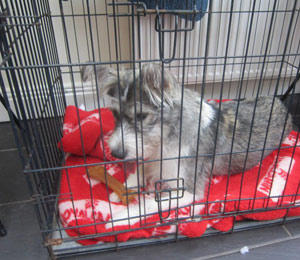
There are several different types of crate, but probably the most common and easy to use is the one that looks like a cage, with one or two doors on the side and/or end. This type is made of wire mesh and folds down for easy storage when not in use. Crates are available from all good pet shops.
What size do I need?
When you choose your dog’s crate it needs to be big enough for him to be able to sit, stand up and turn around in. Remember to allow room for how much your puppy may grow.
How can I make it a nice place, where my dog will want to go?
The crate should be a place where your dog can feel happy and relaxed, so you need to set it up so that it will be cosy and comfortable for him. Put it in a part of your home where you spend a lot of time, so that your dog has you nearby and won’t be lonely. To help keep out draughts, try to place it in a corner and then cover the top, back and perhaps also the sides with a blanket or towel to make it more den-like. Put comfortable bedding inside that is also easy to clean. If you have a puppy, you may need to place some newspaper at one end, in case he has an accident. You will need to give your dog access to water, so put in a water bowl or get one that clips onto the side of the crate, so that it cannot get knocked over.
How can I make my dog like the crate?
It is important that you get your dog used to his crate very gradually and without force. If you just shove him in and shut the door, you’ll frighten him and he won’t want to go in again. Put some treats in the crate to tempt your dog inside. Do this several times a day and start to give your dog all of his meals inside the crate. Don’t close the door yet. If your dog has bedding that he has been using up until now, after a few days place this in the kennel with one of his toys. Give him lots of fuss or a treat whenever you see him go into the crate. When he looks relaxed inside the crate, or when he is eating his dinner in there, close the door for a few moments and then open it again. This should be for only seconds to start with and then slowly build up to minutes.Once your dog is happy with being shut in with you there in the room with him, practice leaving the room for very short periods of time and then returning. Slowly increase the time that you leave him alone.
Puppies tend to get used to an indoor crate very quickly, especially if you use it whenever they need to eat or sleep. Older dogs may take a little longer and need more patience, but should get used to it with time (and a lot of treats!) A crate is particularly useful for house training puppies. As a pup’s metabolism slows down at night time they can generally get through the night without going to the toilet. Your pup should sleep in his crate. As soon as you wake up in the morning take your pup straight outside to go to the toilet.
When should you use a crate?
As well as being a nice place for your dog to ‘chill out’ and a safe place for him to sleep through the night, it can also help you to keep your dog safe at times when you cannot give him all of your attention.
Here are some examples of when it will be most useful:
1. If you have a new puppy and an older dog in your home and you cannot pay close attention to their playtime to make sure it is safe, you can put your puppy into the crate to keep him out of harms way until you are able to watch them both.
2. Puppies and dogs should never be left alone with children. If you cannot be there, then you can pop your dog into the crate so that both child and dog can be safe.
3. If you are busy around the house, cooking for example, then your puppy can be kept safe in the crate.
4. During house-training you can keep your dog or puppy safe in the indoor crate whenever you are unable to keep an eye on him.
5. When your puppy is teething and chewing everything in sight, you can place him in the indoor crate with a safe chew toy so that he doesn’t destroy things that he shouldn’t.
6. If you have to leave your puppy alone for short periods, then being in the indoor crate will make your puppy feel safe as well as preventing toilet accidents and chewing disasters!
7. You can also use the indoor crate when travelling in your car as a safe resting-place.
Punishment?
You must never put your dog into the crate to punish him or to keep him away from the rest of the family. You should never keep your dog in the crate all day. All dogs – puppies and adults – must be taken out regularly for the toilet, exercise, play and training. Do not turn your dog’s home into a prison. Remember that the crate must be a place where your dog feels secure and comfortable at all times.
It is not a place where children (or adults) should be allowed to tease your dog.
It must never be used to punish or frighten your dog.
If a crate is used as a place for punishment, your dog or puppy will never be happy there and will not want to use it as his den.
 Training will teach your dog what is and isn’t acceptable behaviour in your home. Training also goes beyond this in helping to build the bond between dog and human. A dog that is well trained will fit harmoniously into your household. An obedient dog can be confidently introduced to other humans and dogs and be taken to public places and social events. Therefore a well trained dog will be able to experience and enjoy a more varied and interactive life.